
Pros and Cons of Construction Site Drones
As drones become cheaper to build, we are seeing them used in more and more places. Their wide accessibility has made it easier for ordinary folks—not only the tech-savvy—to get their hands on them.
Drones are becoming more practical to own and use, which means they're showing up on more construction sites. They've got cameras, sensors, and software, so they can deliver aerial data that was formerly quite pricey to obtain. Of course, we've got both benefits and limitations to consider. Here’s a quick rundown of the pros and cons.
Pros of Construction Site Drones
Quicker Site SurveysTraditional surveying used to take days and require a lot of manpower on the ground. A drone, on the other hand, only needs a few minutes to grab images of an entire site in minutes. With the right equipment, it can produce orthomosaic maps, 3D models, and point clouds. This makes project managers happy, because they're not waiting on a survey team anymore. Maps are available nearly in real-time.
More Frequent SurveysBecause drones only require one qualified operator, you don't have to wait to schedule a ground crew to visit the site. Just schedule the operator, and make sure that battery is charged. This makes it much easier to get updates as you want them.
Improved safetyDrones don't need to climb scaffolding. They don't need to walk around on framework or unfinished roofs. They don't need to enter unstable areas just to take measurements or photos. High elevation is no issue for a drone. They're also a lot less risky to move around in active areas with a bunch of heavy equipment being operated. If a drone accidentally slams into the side of an excavator bucket, that piece of plastic is the only thing lost.
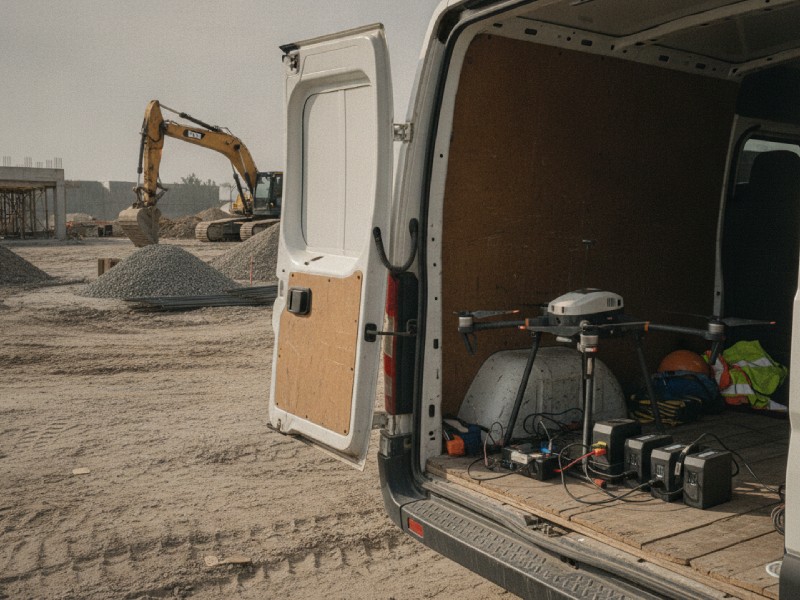
A Construction Drone Transported by a Van
Easily Track Progress, Document Work
When a project owner hears, "It's coming along nicely," that's not as impactful as, "Here's a photo of the actual site." This is also great for project managers, because they can spot deviations early, before getting wildly behind schedule. These construction site photos can be have notes attached to them, making it easier to review progress. From a liability standpoint, good documentation helps avoid or resolve disputes.
Save Money & TimeThe two things we always feel we're short on: time and money. The right tech can help you save on both, though it will require the initial investment in the right drone.
Once you've made that initial investment and you've got a couple trained employees, the cost to actually operate the drone is very low. Having a few backup batteries ready will reduce potential downtime. No special trailers are required to haul a drone to the site either.
Complex or large work sites don't take that much more time for a drone to survey. A team of people, on the other hand, would have substantially more planning to do.
Improved Communication with StakeholdersAs mentioned, having some high-res. photos or 3D models makes it easier to communicate with clients, owners, construction teams. It's much easier to get an idea of progress with an actual picture than it is project timelines and blueprints alone. Virtual walkthroughs are a real crowd pleaser with clients too.
Takeoff and AnalysisIn addition to standard aerial photography, the right attachments can allow for advanced analysis. Some drones are equipped for photgrammetry and LiDAR. They can calculate earthwork quantity, inventory stockpiles, and material movement. Estimators and managers will appreaciate this, so they can stay on top of logistics.
Cons of Construction Site Drones
Upfront and ongoing costsWhile drone cost is mostly upfront, it isn't free to maintain them. High-level drones, like the LiDAR equipped types, often require software subscriptions and training. If your drone is pricey enough, you'll probably want to insure it. Also, batteries are not forever.
Regulatory and operational restrictionsAs easy as it sounds to just buy a drone and start using it, the legal requirements put a damper on implementation. Many locations require drone operators to get certified. Depending on where you're building, you may even need to get flight authorization, as a small plane might. Airspace in some areas can be kind of crowded or delicate, like if you operate near a hospital with a helipad, or even remotely close to an airport.
WeatherHumans are much more waterproof than drones. Wind can prevent you from getting a stable shot, reducing accuracy of scans. Also, rain and fog can get in the way of clear images.
Data processing and skill requirementsIn order to make the raw images useful, you'll need to convert them into maps or 3D models. That's when measurements can be taken and decisions can be made. That means you not only need to operate the drone, you'll need some sophisticated software running on a laptop. That's more money and training. That translates to fewer people who are qualified to do the work.
Privacy, security, and liability concernsThe natural by-product of taking aerial photography is including incidental things in the photos. You may have some work-site neighbors who are not very happy about this, and their complaints can slow down the work.
Limited performance in certain conditionsThere are other physical limitations, aside from weather. Drones can struggle to get good images when they're working near highly reflective surfaces. This can create blurry or incomplete photos. You also have vegetation to consider. Dense trees will certainly get in the way.
Another physical limitation is weight. Advanced sensors add more weight and require more battery drain.
ImplementationNot everyone wants to learn a new tool—especially when they feel like it might threaten their job stability. Acquiring new tools also means trying to integrate it into old ones, like your BIM, project management, or accounting systems. Everybody has to cooperate to get things up and running, and some people will not want to.
At the End of the Day...
Drones, like any technology, have strengths and weaknesses. You can quickly and safely grab loads of worksite information. They may also end up being more of an expense or hassle than they're worth. Large crews stand to benefit the most, while smaller teams may find old-school, reliable techniques best.
You cannot casually get involved in drone work. If you want it to really pay off, you must invest in the right hardware, software, and training. When this all comes together, it's a highly valuable tool on the site.