
Countertop Options: What's Worth the Money?
When clients ask what the best countertop is, you'll want to be prepared. Of course, there's no single answer. It depends on how hard the kitchen gets used, the look the client wants, how much they're willing to spend, and how well they can maintain it. Here's a straight rundown of the main options, with their pros and cons.
Granite
This is one of the most popular natural stones. Every slab is unique, which is what some people love about it. It's hard and heat-resistant. It should hold up well if it's sealed properly.
Downside: It needs to be resealed every year or so for best results. If not, it can stain. Some colors get etched or darkened if they're being heavily used. And because every slab is different, what you pick in the showroom might look a little different once it's cut and installed.
Best for: People who want a natural look and don't mind a little maintenance.Quartz (Engineered Quartz)
Engineered quartz is made from natural quartz, but held together with polymer resin and dyed with pigments. It looks natural, because it is made from a natural stone.
Quartz is often recommended by contractors, and has gained a lot of popularity. It's consistent in color and pattern, so it's easier to match with a kitchen design. It's non-porous, so sealing is not necessary. It's also very durable against stains and scratches.
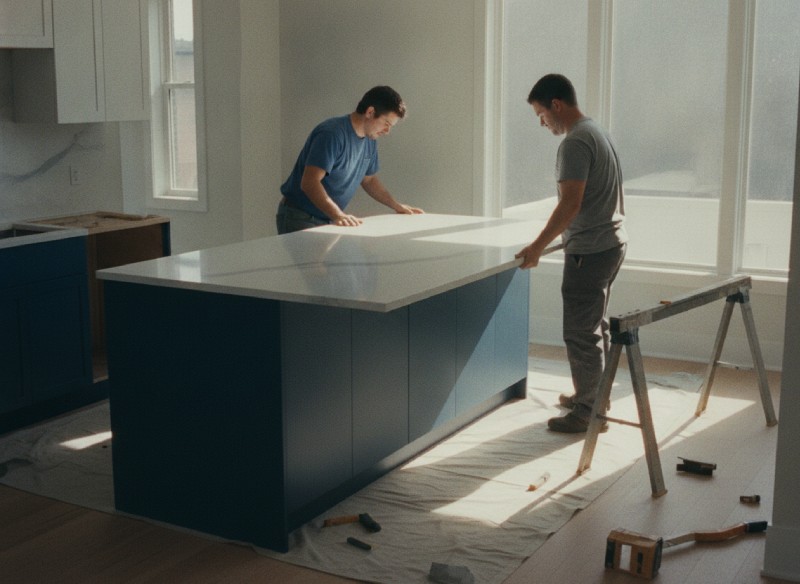
Engineered quartz countertop is durable and attractive.
Downside: It's all around pretty great, but everything has its kryptonite. It can be damaged by extreme heat, so you don't want set a hot pan straight from the stove on it. It's pricey too. You can save money with cheaper lines, but the low-end options can look a little plastic up close.
Best for: Busy families, rental properties, or anyone who wants low maintenance.
Marble
Marble is beautiful. There's a reason high-end kitchens still use it. It has smooth natural veining, giving it some character. Right off the bat though, you should know it's softer than some other options. It scratches, etches from lemon juice and wine, and stains if you're not careful. A lot of clients fall in love with the look, but then have a different opinion six months later when it starts showing its wear and tear. It's very nice looking, indeed, but it's not necessarily a resilient surface you'd want to use in a busy kitchen.
Best for: People who like a traditional look and are willing to either be careful or accept the aging marks.
Laminate
Laminate is not known for its natural beauty. It's known as a flexible budget option. Modern laminates look better than they used to though. Some of the textured ones can pass for stone when you're standing a few feet away. They're easy to clean, and you can replace just the top if it gets damaged.
Downside: It can burn, chip, or peel at the edges over time. Water can get under the seams if they're not sealed well. It won't hold up like stone in a heavy-use kitchen.
Best for: Secondary kitchens, rentals, or tight budgets where you still want a clean look.
Butcher Block / Wood
Warm, natural, and great for people who actually cook and like a softer surface for chopping (with a board, ideally). You can sand and re-oil it when it starts looking tired.
Downside: It needs regular oiling, can stain or warp if water sits on it, and isn't ideal next to a sink without careful sealing. It's obviously not as durable as stone, and knives will mark it.
Best for: Island tops or prep areas where you want that warm feel.
Concrete
This allows you a custom look, as it can be tinted or polished however you want. It's very durable once it's cured and sealed. However, it's heavy, and it can crack if not done right. It will need periodic re-sealing. Temperature swings and settling in the house can cause issues over time, but most climate controlled environments should be fine.
Best for: Modern or industrial-style kitchens where the client wants something unique and is okay with a bit of "character."
Practical Notes for the Field
- Always factor in the full cost: the material, fabrication, edge profile, sink cutouts, and installation. A cheap slab can get expensive once it's cut and put in.
- Consider the usage. Heavy use, or occasional use? Lots of kids means constant use, and you'll need to lean toward durable options.
- Edge profiles matter. A simple eased edge is easier to keep clean than a fancy edge that can trap crumbs and liquid.
- Samples in the showroom under perfect lighting don't always match what you'll see in the actual kitchen. Look at bigger pieces, if you can.
- Of course, the client is right, and you'll want to install what they request. However, you'll want to consider how they'll like the stone in a year from now. They'll be more likely to recommend you to their neighbors if they like the outcome.
There's no perfect countertop. There's only what's right for the house, the budget, and kitchen needs. If a client is stuck between two options, you can ask them how much maintenance they're willing to do. That should narrow it down really fast.
If you're pricing a job or helping a client decide, walk them through the real-world trade-offs instead of just the marketing pictures. They'll thank you for it later.